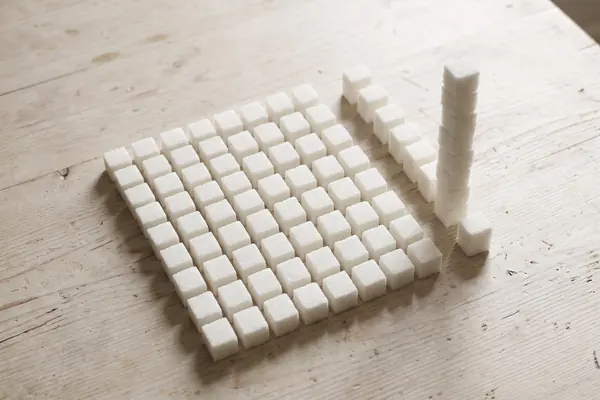

BIG
Capitals for the large
Mega (M), giga (G) and tera (T) mean 10⁶, 10⁹ and 10¹². NIST notes that multiples use capital symbols, except kilo (k), hecto (h) and deca (da).
Pick a prefix
POWERS OF TEN, PLAINLY
10³⁰ to 10⁻³⁰
AI-generated image, not a photograph of a real person or place.
Kilo, mega, giga: each is just ten multiplied by itself.
The International System of Units has 24 official prefixes, from quecto (10⁻³⁰) to quetta (10³⁰). Learn the pattern once and kilograms, nanometres and gigabytes all read the same way.
THE SHORT ANSWER
Put a prefix in front of a unit
and you multiply it by a fixed power of ten.
BIG
Mega (M), giga (G) and tera (T) mean 10⁶, 10⁹ and 10¹². NIST notes that multiples use capital symbols, except kilo (k), hecto (h) and deca (da).
Pick a prefixSMALL
Milli (m), micro (µ) and nano (n) mean 10⁻³, 10⁻⁶ and 10⁻⁹. Every prefix for a fraction of a unit uses a lowercase symbol.
See the rangePATTERN
Apart from hecto, deca, deci and centi, each prefix is 1,000 times the one before it, so kilo to mega to giga is ×1,000 each time.
Read them quickly
FOUR WAYS TO READ THEM
You do not need to memorise all 24. A few habits make most prefixes you meet on labels, screens and science pages easy to read.
From kilo upwards and milli downwards, each named step is a factor of 1,000: three more zeros, or three more places after the point.
M is mega (a million) but m is milli (a thousandth). The capital or lowercase letter changes the size a billionfold.
Compound prefixes are not allowed, so a thousandth of a gram is 1 mg, never 1 µkg.
Earth's mass is about 6 ronnagrams rather than 6,000 yottagrams. Pick the prefix that keeps the number small and readable.
TWO NUMBERS WORTH KNOWING
One figure on how far the prefixes reach,
one on the most recent change.
60 steps
Powers of ten from quecto to quetta
The official list runs from quecto, 10⁻³⁰, to quetta, 10³⁰: sixty powers of ten from the smallest prefix to the largest, covered by 24 named prefixes.
RANGE · BIPM
4 new
Prefixes added at the 27th CGPM
Ronna, quetta, ronto and quecto were added in 2022, the first new prefixes since zetta, yotta, zepto and yocto in 1991.
2022 · CGPM
The CGPM resolution cites the needs of data science to express digital information beyond 10²⁴, and the wish to stop unofficial prefix names being adopted in other communities.
PICK A PREFIX
Choose a prefix to see the power of ten it stands for. The bar shows whether it shrinks a unit or grows it.
Values from the BIPM list of SI prefixes and the NIST prefix table.

SCALE IN THE SOLAR SYSTEM
NASA describes distances by how long light takes to cross them. Light moves at about 300,000 km per second and takes about 8.3 minutes to travel the 149,600,000 km from the Sun to Earth.
In prefixes, that distance is about 150 gigametres. NASA puts the nearest star, Proxima Centauri, at about 4.2 light years away, which is about 265,000 times the Sun to Earth distance.
In conversation
Twenty-four. The BIPM list runs from quecto (10⁻³⁰) up to quetta (10³⁰), including familiar ones such as milli, kilo, mega and giga.
The twelve multiples, from the largest: quetta (Q) 10³⁰, ronna (R) 10²⁷, yotta (Y) 10²⁴, zetta (Z) 10²¹, exa (E) 10¹⁸, peta (P) 10¹⁵, tera (T) 10¹², giga (G) 10⁹, mega (M) 10⁶, kilo (k) 10³, hecto (h) 10² and deca (da) 10¹. The twelve submultiples: deci (d) 10⁻¹, centi (c) 10⁻², milli (m) 10⁻³, micro (µ) 10⁻⁶, nano (n) 10⁻⁹, pico (p) 10⁻¹², femto (f) 10⁻¹⁵, atto (a) 10⁻¹⁸, zepto (z) 10⁻²¹, yocto (y) 10⁻²⁴, ronto (r) 10⁻²⁷ and quecto (q) 10⁻³⁰.
Deca, hecto, kilo, deci, centi and milli survive from the eight original prefixes of 1795. Mega, giga, tera, micro, nano and pico were added in 1960, femto and atto in 1964, peta and exa in 1975, zetta, yotta, zepto and yocto in 1991, and ronna, quetta, ronto and quecto in 2022. The other two 1795 prefixes, myria and myrio, were dropped in 1960.
In 2022, at the 27th General Conference on Weights and Measures (CGPM). Ronna (10²⁷), quetta (10³⁰), ronto (10⁻²⁷) and quecto (10⁻³⁰) joined the list. The previous additions were in 1991.
The CGPM resolution points to data science needing to express amounts of digital information larger than 10²⁴, and to the risk of unofficial prefix names catching on. Very small ones help in quantum science and particle physics.
NIST explains that symbols for multiples are capitals except for kilo (k), hecto (h) and deca (da), while all symbols for submultiples are lowercase. So k is kilo, while M is mega and m is milli.
Both refer to 10¹. The BIPM list uses deca; NIST uses deka, following American English spelling, and notes deca as the British spelling. The symbol is da either way.
Quetta, the largest SI prefix: one quetta is 10³⁰. It was added in 2022, together with ronna (10²⁷), ronto (10⁻²⁷) and quecto (10⁻³⁰), the first new prefixes since 1991.
Each figure on this page comes from the sources below.
ABOUT THIS NAME
doodlepowers.com is part of the DoodleSale portfolio. It isn't in an auction right now, but you can ask about leasing it.